The Daily Beast: 4 Principles For a Libertarian National Security State – Part 4

4. Track the effectiveness.


Speaking of the TSA leads directly into a final way of minimizing the excesses and wastefulness of a national surveillance state. Every policy and every agency needs to be reviewed for effectiveness over time. On its 10-year anniversary, the TSA was the subject of a withering report by Reps. John Mica (R-Fla.) and Paul Broun (R-Ga.), who noted that $56 billion invested in making flying safer after 9/11 had not increased safety by any appreciable measure.


At the same, TSA personnel increased by 400 percent while passenger volume had increased by less than 12 percent. More recently, in July, the GAO released a report documenting a 27 percent increase in TSA-employee misconduct between 2010 and 2012.


A variety of books over the past few years—including Moises Naim’s new The End of Power and Matt Welch’s and my The Declaration of Independents (2011)—document the way in which power and authority is leaching out of traditional centralized authorities such as governments, corporations, and churches. This result is a change in the relationship between state and citizen, producer and consumer, priest and congregant. What was once a far more hierarchical, top-down, and force-fed relationship is much flatter and more voluntary. Companies must do more than ever to placate their workers and customers, and even the Catholic Church can no longer issue doctrine without regard for the reaction of believers.


Governments, of course, maintain more power but even they rest ultimately upon the consent of the governed. At least since the attacks of September 11, 2001, our own government has used real and imaginary threats to engage in behavior that is not just increasingly being revealed to the public (thank you, Edward Snowden and other whistleblowers) but being reviled as noxious, misguided, and offensive to basic civil liberties and freedom. It’s little wonder then, that the president’s and Congress’ approval ratings are so low. Would that they would recognize us as partners in the war on terror rather than as potential combatants. They might just make our world a bit safer and be able to get on with their jobs of actually governing.

—-

Click below for the full article.
http://www.thedailybeast.com/articles/2013/09/14/four-principles-for-a-libertarian-national-security-state.html

The Daily Beast: 4 Principles For a Libertarian National Security State – Part 3

3. Target the bad guys.


Supporters of a massive, effectively unregulated surveillance state are constantly touting the benefits of dragnet-style reporting requirements and snooping. For instance, Sen. Dianne Feinstein (D-Calif.) and Rep. Mike Rogers (R-Mich.) have said repeatedly that NSA logging of phone call metadata and internet traffic were instrumental in the 2009 arrests of Najibullah Zazi, who plotted to blow up New York’s subway system, and David Headley, who traveled to Mumbai to scope the Taj Mahal hotel for an attack. Yet it turns out that neither case provides any evidence for the efficacy of widespread surveillance programs.


Indeed, they point to the effectiveness of old-fashioned intelligence and police work, where authorities keep tabs on people and groups with well-known reputations for violence and terrorism (Zazi was picked up based on tips from British agents; as a former Drug Enforcment Adminstration informant (!), Headley was well-known to investigators).


Surveillance-state supporters are constantly invoking the “needle-in-the-haystack” metaphor, the idea being that finding terrorists requires patient sifting through huge mounds of extraneous material. It’s odd then, isn’t it, that the basic urge is always to increase the size of the haystack rather than decrease it. Consider how The PATRIOT Act vastly increased the number of “currency transaction reports” (CTRs) that banks needed to file with the federal government in the name of outing terrorist money flows. Originally created to help snag drug kingpins, some 12 million CTRs were being filed annually before 9/11—a number that was already overwhelming any ability to use the information effectively. Creating a bigger haystack isn’t a smart way to find bad guys hidden within.


The same dynamic is at work in arguably the most-visible and least-popular excresence of the war on terror: the creation of the Transportation Security Administration (TSA) and the imposition of invasive and time-consuming procedures at the nation’s airports. The threat of hijacked planes being used as missiles was effectively ended on the morning of 9/11 itself, when passengers charged hijackers on United Flt 93 and drove the plane into a Pennsylvania field. The barricading of cockpit doors shortly after 9/11 ended the possibility of a repeat of 9/11. Yet we continue to fund a massively expensive system to search all people boarding airplanes in a long-running exercise in “security theater” that accomplishes nothing.


The Daily Beast: 4 Principles For a Libertarian National Security State – Part 2

2. Legal authority is not optional.

Whether we’re discussing the use of drones, metadata dragnets, or anything else that seems creepy at first mention, the real anxiety stems from a lack of a clearly articulated and defensible legal framework. As disconcerting as it was to learn of a secret presidential kill list, it was far worse to realize that there was essentially no controlling legal authority which bound Barack Obama’s decisionmaking process. Similarly, recognizing that the NSA is not simply unwilling to follow the law but incapable of even understanding it is unacceptable.

No government—or branch of government—wants to have its decisions vetted by any sort of watchdog, but that’s the only way to minimize errors and build confidence that national security operations are not ultimately creating a government within a government. We have reached the point where the courts originally set up by 1978’s FISA (itself a product of an earlier era of massive violations of civil liberties), need a complete overhaul. If even sitting senators have trouble getting information about how and why the government is collecting information on citizens, something is wrong beyond repair.

The same is true for the foundational document in the War on Terror, which was passed by Congress on September 14, 2001 and grants vague and sweeping powers to the president of the United States. It reads, “The president is authorized to use all necessary and appropriate force against those nations, organizations, or persons he determines planned, authorized, committed, or aided the terrorist attacks that occurred on September 11, 2001, or harbored such organizations or persons, in order to prevent any future acts of international terrorism against the United States by such nations, organizations or persons.” A dozen years after the 9/11 attacks, any such declaration needs to be scrapped, rewritten, and voted on—in the cold light of day, not a hot flash of panic.

What was once a far more hierarchical, top-down, and force-fed relationship is much flatter and more voluntary.


The Daily Beast: 4 Principles For a Libertarian National Security State – Part 1

Like hits for Katy Perry, the scandals for the National Security Agency just keep coming. In the wake of revelations that the NSA has been tracking virtually every phone call ever made and sifting through Internet data like a crazed prospector panning for gold at Sutter’s Mill, there’s yet more disturbing news with every passing day.

The latest is that between 2006 and 2009, Politico reports, the NSA lied about its activities to the Foreign Intelligence Surveillance Court charged with authorizing its snooping. Worse still, this outcome is a toxic mix of spy-agency overreach and bureaucratic incompetence. “An internal inquiry into the misstatements also found that no one at the NSA understood how the entire call-tracking program worked,” says Politico, which quotes an unnamed source who explains, “There was nobody at NSA who really had a full idea of how the program was operating at the time.”

This is as outrageous as it is dispiriting (and predictable). But a dozen years after the 9/11 attacks ushered in the global war on terror, there’s no reason that we should have to live in fear of our government’s efforts to keep us safe and warm. Here are four basic principles that should inform what might be called a libertarian national security state. That is, one that helps to protects us without routinely transgressing constitutional guarantees to privacy, due process, freedom from illegal searches, and the right to be left alone.

1. Transparency uber alles.

One of the main reasons that Barack Obama’s approval ratings are in the crapper is because of his epic failure to live up to his promise to run what he guaranteed would be the most transparent administration EVAH. That’s especially true when it comes to national security issues. Even the most hardened anti-terror hawks have been shocked by revelations of widespread secret drone strikes, extra-judicial kill lists, a war on leakers and journalists, and ubiquitous snooping on Americans.

However disturbing it was to learn of massive surveillance of law-abiding citizens in violation of restrictions on the NSA, it was made even worse by blatant lies to the American public. When Director of National Intelligence James Clapper flat-out lied under oath to Sen. Ron Wyden (D-Ore.), there should have been immediate and visible consequences, both in terms of personnel and policy.

In an age of Wikileaks, Anonymous, Edward Snowden, and other ultimately unstoppable forces, transparency isn’t just a buzzword, like green energy or farm-fresh. It’s an eventuality and the first government that levels with its people about what it’s actually up to will be far stronger and resilient than one that is constantly hiding its activities. We’re grownups, for Christ’s sake, and if some sort of restriction on our freedoms or oversight on our activities is actually defensible and necessary for a legitimate security purpose, we’ll respond in a responsible way.

Every bullshit, after-the-fact rationalization drives a deeper wedge between citizens and government. White House press releases like the one issued on July 23 don’t help. “In light of the recent unauthorized disclosures,” it read, “the President has said that he welcomes a debate about how best to simultaneously safeguard both our national security and the privacy of our citizens.” In such moments, Barack Obama moves beyond cynicism into the realm of pure insult.

Silver Bear Cafe: The Truth of the Federal Reserve System – The biggest financial crime in the history of the United States

In this short article I will discuss the basic mechanics of the biggest financial crime        in the history of the United States and some elements of how this crime, conducted by the        Federal Reserve System, is cheating all Americans every day out of the wages which they        receive for their labor. A future article will discuss how the savings which Americans are        putting aside for their future are being slowly and steadily stolen by this same group.        But there is first a even more important question to ask : While you have recently seen        the media discuss the financial scandal regarding the Enron corporation why haven’t you        heard one word about what I am about to discuss which in size makes Enron look like a ant        compared to Mount Everest?

From the beginnings of our nation there was a great debate and battle over many years        regarding a basic question of how the nation will function : Who shall issue the money of        the nation? The answer to the question of who shall issue ( make ) the money of the nation        boiled down to 2 possibilities –

  1. The government shall use the sovereign powers granted to it via the Constitution to          issue money.
  2. A private corporation, established via legislation, shall take over the function of          issuing money.

While a fuller understanding of the history of the battles over this issue can be found        at the various forums and websites to which we will refer you to for greater information        the quickest summation of the answer to the problem is that :

  1. Government issue of money is constitutionally, monetarily, and financially the soundest          policy for the prosperity of the nation.
  2. The issuance of the money of the nation by a private corporation leads to the draining          of the resources of the nation to the private corporation which controls the issuance of          money.

The summated result of this action is that the private corporation, unaccountable to        the people of the nation, controls the nation as it controls the flow of money within the        nation. As part of a mountain of evidence that the private corporation controls the nation        I refer you now to the following website : http://www.algaoaktree.com/MoneyMenu.htm

You will be taken to a website which has the best explanation of the money situation  that I know of and it is here where you will learn of the total corruption of the Federal  Reserve System, the private corporation which currently controls the issuance of money  within our nation.

Please take your time and read the many extremely well written articles at this site        completely. After reading the articles on this site you may ask one of the questions which        I did upon learning the truth of our monetary system : Even though the subject of money is        a somewhat technical one, why isn’t the information found on this site more well known to        the citizens of our nation?

——

Click below for the full article.

http://www.silverbearcafe.com/private/09.13/criminalfed.html

Washington Post: U.S. weapons reaching Syrian rebels

The CIA has begun delivering weapons to rebels in Syria, ending months of delay in lethal aid that had been promised by the Obama administration, according to U.S. officials and Syrian figures. The shipments began streaming into the country over the past two weeks, along with separate deliveries by the State Department of vehicles and other gear — a flow of material that marks a major escalation of the U.S. role in Syria’s civil war.

The arms shipments, which are limited to light weapons and other munitions that can be tracked, began arriving in Syria at a moment of heightened tensions over threats by President Obama to order missile strikes to punish the regime of Bashar al-Assad for his alleged use of chemical weapons in a deadly attack near Damascus last month.

The arms are being delivered as the United States is also shipping new types of nonlethal gear to rebels. That aid includes vehicles, sophisticated communications equipment and advanced combat medical kits.

U.S. officials hope that, taken together, the weapons and gear will boost the profile and prowess of rebel fighters in a conflict that started about 21/2 years ago.

Although the Obama administration signaled months ago that it would increase aid to Syrian rebels, the efforts have lagged because of the logistical challenges involved in delivering equipment in a war zone and officials’ fears that any assistance could wind up in the hands of jihadists. Secretary of State John F. Kerry had promised in April that the nonlethal aid would start flowing “in a matter of weeks.”

The delays prompted several senior U.S. lawmakers to chide the Obama administration for not moving more quickly to aid the Syrian opposition after promising lethal assistance in June. The criticism has grown louder amid the debate over whether Washington should use military force against the Syrian regime, with some lawmakers withholding support until the administration committed to providing the rebels with more assistance.

———–

Click below for the full article.

http://www.washingtonpost.com/world/national-security/cia-begins-weapons-delivery-to-syrian-rebels/2013/09/11/9fcf2ed8-1b0c-11e3-a628-7e6dde8f889d_story.html

AP: Lingering doubts over Syria gas attack evidence

The U.S. government insists it has the intelligence to prove it, but the public has yet to see a single piece of concrete evidence produced by U.S. intelligence — no satellite imagery, no transcripts of Syrian military communications — connecting the government of President Bashar Assad to the alleged chemical weapons attack last month that killed hundreds of people.

In its absence, Damascus and its ally Russia have aggressively pushed another scenario: that rebels carried out the Aug. 21 chemical attack. Neither has produced evidence for that case, either. That’s left more questions than answers as the U.S. threatens a possible military strike.

The early morning assault in a rebel-held Damascus suburb known as Ghouta was said to be the deadliest chemical weapons attack in Syria’s 2½-year civil war. Survivors’ accounts, photographs of many of the dead wrapped peacefully in white sheets and dozens of videos showing victims in spasms and gasping for breath shocked the world and moved President Barack Obama to call for action because the use of chemical weapons crossed the red line he had drawn a year earlier.

Yet one week after Secretary of State John Kerry outlined the case against Assad, Americans — at least those without access to classified reports — haven’t seen a shred of his proof.

There is open-source evidence that provides clues about the attack, including videos of fragments from the rockets that analysts believe were likely used. U.S. officials on Saturday released a compilation of videos showing victims, including children, exhibiting what appear to be symptoms of nerve gas poisoning. Some experts think the size of the strike, and the amount of toxic chemicals that appear to have been delivered, make it doubtful that the rebels could have carried it out.

What’s missing from the public record is direct proof, rather than circumstantial evidence, tying this to the regime.

The Obama administration, searching for support from a divided Congress and skeptical world leaders, says its own assessment is based mainly on satellite and signals intelligence, including intercepted communications and satellite images indicating that in the three days prior to the attack that the regime was preparing to use poisonous gas.

But multiple requests to view that satellite imagery have been denied, though the administration produced copious amounts of satellite imagery earlier in the war to show the results of the Syrian regime’s military onslaught. When asked Friday whether such imagery would be made available showing the Aug. 21 incident, a spokesman referred The Associated Press to a map produced by the White House last week that shows what officials say are the unconfirmed areas that were attacked.

The Obama administration maintains it intercepted communications from a senior Syrian official on the use of chemical weapons, but requests to see that transcript have been denied. So has a request by the AP to see a transcript of communications allegedly ordering Syrian military personnel to prepare for a chemical weapons attack by readying gas masks.

The U.S. administration says its evidence is classified and is only sharing details in closed-door briefings with members of Congress and key allies.

Yet the assessment, also based on accounts by Syrian activists and hundreds of YouTube videos of the attack’s aftermath, has confounded many experts who cannot fathom what might have motivated Assad to unleash weapons of mass destruction on his own people — especially while U.N. experts were nearby and at a time when his troops had the upper hand on the ground.

Rebels who accuse Assad of the attack have suggested he had learned of fighters’ plans to advance on Damascus, his seat of power, and ordered the gassing to prevent that.

‘‘We can’t get our heads around this — why would any commander agree to rocketing a suburb of Damascus with chemical weapons for only a very short-term tactical gain for what is a long-term disaster,’’ said Charles Heyman, a former British military officer who edits The Armed Forces of the U.K., an authoritative bi-annual review of British forces.

Inconsistencies over the death toll and other details related to the attack also have fueled doubts among skeptics.

The Obama administration says 1,429 people died in 12 locations mostly east of the capital, an estimate close to the one put out by the Western-backed Syrian National Coalition. When asked for victims’ names, however, the group provided a list of 395.  On that list, some of the victims were identified by a first name only or said to be members of a certain family. There was no explanation for the hundreds of missing names.

——-

Click here for the full article.

http://www.boston.com/news/world/middle-east/2013/09/08/lingering-doubts-over-syria-gas-attack-evidence/miUpIDnRiga99r5PCERY1K/story.html

Yahoo News: Then and now: Obama on use of US military might

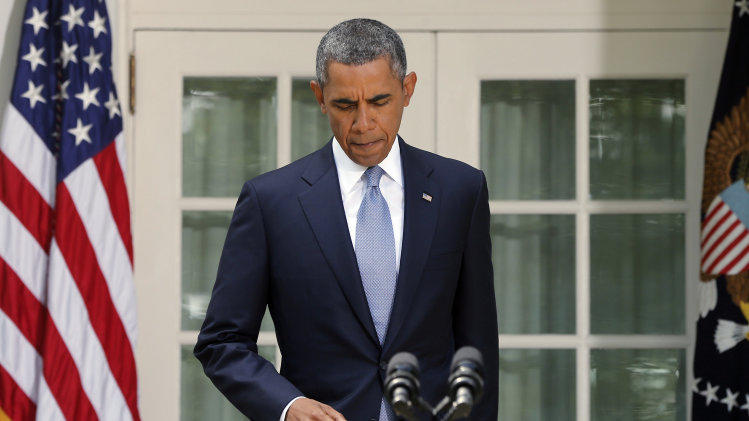
In this Aug. 31, 2013, photo, President Barack Obama arrives to make a statement about Syria in the Rose Garden at the White House in Washington. As a candidate Obama championed restraint and global cooperation when faced with security threats but noww, as commander in chief of a world superpower, his rhetoric of the past is being tested by the reality of today as he presses Congress to allow the United States to launch a military strike against the regime of Syrian President Bashar Assad over the objections of most major U.S. allies. (AP Photo/Charles Dharapak)
As a candidate focused on his own election, Barack Obama championed restraint and global cooperation when faced with security threats.Now, as commander in chief of a world superpower, his rhetoric of the past is being tested by the reality of today as he presses Congress to allow the United States to launch a military strike against the regime of Syrian President Bashar Assad, over the objections of most major U.S. allies.

It’s a posture that conflicts with positions he took as a young senator, a 2008 presidential candidate and even a first-term president as he cast himself as a counterweight to the more aggressive approach to national security embodied by his Republican predecessor, President George W. Bush.

The Democratic president long has advocated a U.S. foreign policy that prioritizes negotiation over confrontation, humility over diplomatic bravado and communal action over unilateralism.

Those positions are under question as Obama seeks the approval of Congress back home and as he meets with skeptical world leaders abroad while at the G-20 summit in Russia this week.

A look at some of Obama’s historical and recent comments on the use of America’s military might:

ON CONGRESS

THEN: “In instances of self-defense, the president would be within his constitutional authority to act before advising Congress or seeking its consent. History has shown us time and again, however, that military action is most successful when it is authorized and supported by the legislative branch.” — Response to candidate questionnaire from The Boston Globe, December 2007.

NOW: “As commander in chief, I always preserve the right and the responsibility to act on behalf of America’s national security. I do not believe that I was required to take this to Congress. But I did not take this to Congress just because it’s an empty exercise. I think it’s important to have Congress’ support on it.” — News conference in Stockholm, Sept. 4, 2013.

ON ACTING ALONE

THEN: “In a world in which threats are more diffuse and missions more complex, America cannot act alone. America alone cannot secure the peace.” — Speech accepting Nobel Peace Prize, December 2009.

NOW: “I’m comfortable going forward without the approval of a United Nations Security Council that, so far, has been completely paralyzed and unwilling to hold Assad accountable.” — Remarks in the White House Rose Garden, Aug. 31, 2013.

ON APPETITE FOR WAR

THEN: “It is easier to start wars than to end them. It is easier to blame others than to look inward, to see what is different about someone than to find the things we share. But we should choose the right path, not just the easy path.” — Speech in Cairo, June 2009.

NOW: “The American people, understandably, want us to be focused on the business of rebuilding our economy here and putting people back to work. And I assure you, nobody ends up being more war-weary than me. But what I also believe is that part of our obligation as a leader in the world is making sure that when you have a regime that is willing to use weapons that are prohibited by international norms on their own people, including children, that they are held to account.” — Remarks at meeting with Baltic leaders, Aug. 30, 2013.

ON JUSTIFICATION

THEN: “We may not always have national security issues at stake, but we have moral issues at stake. If we could have intervened effectively in the Holocaust, who among us would say that we had a moral obligation not to go in? … And so I do believe that we have to consider it as part of our interests, our national interests, in intervening where possible.” — Presidential debate, October 2008.

NOW: “This kind of attack is a challenge to the world. We cannot accept a world where women and children and innocent civilians are gassed on a terrible scale. This kind of attack threatens our national security interests by violating well-established international norms against the use of chemical weapons. … If we are saying in a clear and decisive but very limited way, we send a shot across the bow saying, ‘Stop doing this,’ that can have a positive impact on our national security over the long term.” — Remarks at meeting with Baltic leaders, Aug. 30, 2013.

——————-

Click below for the full article.

http://news.yahoo.com/then-now-obama-us-military-might-112844522–politics.html