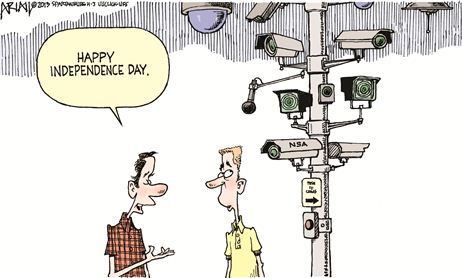
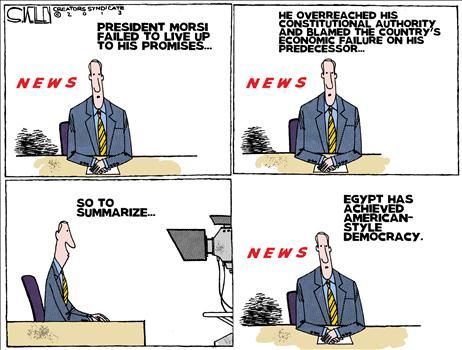
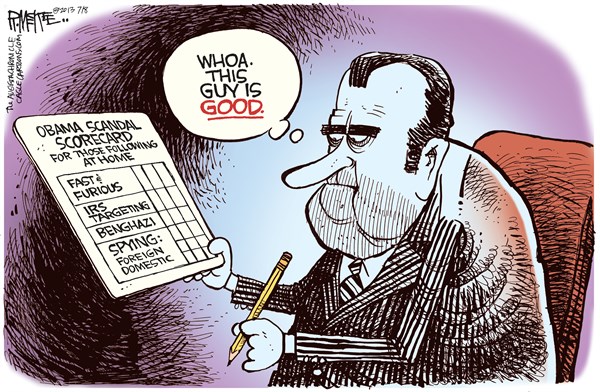
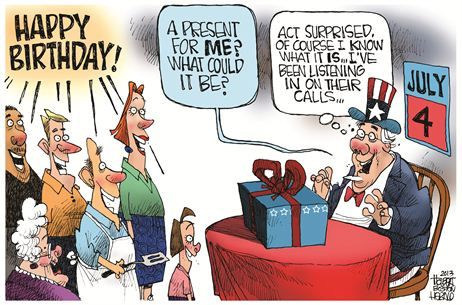
The Liberty Report Take: Well, it appears that Obama supporters are officially IN for repealing the Bill of Rights. (And for the record, this would probably work for most W. supporters too.)
Monday Morning Blues Buster: 07/08/2013
Monday Morning Humor for July 8, 2013.



Video: Militarization of Police: Peace Officers to Storm Troopers | Big Brother Watch
Happy Fourth of July America: Video: 4th of July DUI Checkpoint – Drug Dogs, Searched without Consent, Rights Taken Away, while Innocent
A man was pulled over and searched by police on the 4th of July at a DUI checkpoint in Murfreesboro, Tennessee. Although the man repeatedly exercised his constitutional rights to not be searched and followed the law, the officers bullied him and forced him out of the vehicle despite committing no crime. The motorist’s car was then searched by a K-9 unit who was given a false alert signal by the police officer in order to search the vehicle for drugs.
From the video:
Tennessee State Trooper AJ Ross orders me to pull over and get out of my car, bullies me around, gets the drug sniffing K-9, lies about me having “Illegal Drugs” in the car, searches without consent, and tells me that it is ok to take away my freedom. All while not being detained. All this harassment because my window was not lowered enough to his preference. I broke no laws whatsoever. All of this on a day that we are supposed to be celebrating freedom and liberty. This checkpoint was in Murfreesboro, TN.
Times Dispatch: Commit any felonies lately?
Elizabeth Daly went to jail over a case of bottled water.
According to the Charlottesville Daily Progress, shortly after 10 p.m. April 11, the University of Virginia student bought ice cream, cookie dough and a carton of LaCroix sparkling water from the Harris Teeter grocery store at the popular Barracks Road Shopping Center. In the parking lot, a half-dozen men and a woman approached her car, flashing some kind of badges. One jumped on the hood. Another drew a gun. Others started trying to break the windows.
Daly understandably panicked. With her roommate in the passenger seat yelling “Go, go, go!” Daly drove off, hoping to reach the nearest police station. The women dialed 911. Then a vehicle with lights and sirens pulled them over, and the situation clarified: The people who had swarmed Daly’s vehicle were plainclothes agents of the Virginia Department of Alcoholic Beverage Control. The agents had thought the sparkling water was a 12-pack of beer.
Did the ABC’s enforcers apologize? Not in the slightest. They charged Daly with three felonies: two for assaulting an officer (her vehicle had grazed two agents; neither was hurt) and one for eluding the police. Last week, the commonwealth’s attorney dropped the charges.
The agents’ excessive display of force is outrageously disproportionate to the offense they mistakenly thought they witnessed: an underage purchase of alcohol. But in a sense, Daly got off easy. A couple of weeks after her ordeal, a 61-year-old man in Tennessee was killed when the police executed a drug raid on the wrong house. A few weeks later, in another wrong-house raid, police officers killed a dog belonging to an Army veteran. These are not isolated incidents; for more information, visit the interactive map at www.cato.org/raidmap.
They are, however, part and parcel of two broader phenomena. One is the militarization of domestic law enforcement. In recent years, police departments have widely adopted military tactics, military equipment (armored personnel carriers, flash-bang grenades) — and, sometimes, the mindset of military conquerors rather than domestic peacekeepers.
The other phenomenon is the increasing degree to which civilians are subject to criminal prosecution for noncriminal acts, including exercising the constitutionally protected right to free speech.
Last week, A.J. Marin was arrested in Harrisburg, Pa., for writing in chalk on the sidewalk. Marin was participating in a health care demonstration outside Gov. Tom Corbett’s residence when he wrote, “Governor Corbett has health insurance, we should too.” Authorities charged Marin with writing “a derogatory remark about the governor on the sidewalk.” The horror.
This follows the case of Jeff Olson, who chalked messages such as “Stop big banks” outside branches of Bank of America last year. Law professor Jonathan Turley reports that prosecutors brought 13 vandalism charges against him. Moreover, the judge in the case recently prohibited Olson’s attorney from “mentioning the First Amendment, free speech,” or anything like them during the trial.
In May, a Texas woman was arrested for asking to see a warrant for the arrest of her 11-year-old son. “She spent the night in jail while her son was left at home,” reports Fox34 News. The son never was arrested. Also in Texas, Justin Carter has spent months in jail — and faces eight years more — for making an admittedly atrocious joke about shooting up a school in an online chat. Though he was plainly kidding, authorities charged him with making a terrorist threat.
Federal prosecutors also recently used an anti-terrorism measure to seize almost $70,000 from the owners of a Maryland dairy. Randy and Karen Sowers had made several bank deposits of just under $10,000 to avoid the headache of filing federal reports required for sums over that amount. The feds charged them with unlawful “structuring.” Last week, they settled the case. Authorities kept half their money to teach them a lesson.
“I broke the law yesterday,” writes George Mason economics professor Alex Tabarrok, “and I probably will break the law tomorrow. Don’t mistake me, I have done nothing wrong. I don’t even know what laws I have broken. … It’s hard for anyone to live today without breaking the law. Doubt me? Have you ever thrown out some junk mail that … was addressed to someone else? That’s a violation of federal law punishable by up to five years in prison.” Tabarrok notes that lawyer Harvey Silverglate thinks the typical American commits “Three Felonies a Day” — the title of Silverglate’s book on the subject.
As The Wall Street Journal has reported, lawmakers in Washington have greatly eroded the notion of mens rea — the principle that you need criminal intent in order to commit a crime. Thanks to a proliferating number of obscure offenses, Americans now resemble the condemned souls in Jonathan Edwards’ “Sinners in the Hands of an Angry God” — spared from perdition only by the temporary forbearance of those who sit in judgment.
——
Click below for the full article.
http://mobi.timesdispatch.com/richmond/db_/contentdetail.htm?contentguid=A0157ha4&full=true#display
Video: Fourth of July Reflection, What if we actually had a sound (and constitutional) foreign policy?
On the anniversary of the Declaration of Independence for the GREATEST country in the world, let us reflect as to what our foreign policy should be going forward. What would the founding fathers have wanted? Does our current foreign policy follow the constitution? What does our current foreign policy do to our national debt? Does our foreign policy actually make us safer? Please keep those questions in mind when watching this video…..
CNN Money: Delay in Obamacare – what you need to know
The Obamacare employer mandate has been delayed by a year to 2015, meaning that many businesses can push back providing worker health insurance a bit longer.
When the Affordable Care Act was passed in 2010, it required that companies with 50-plus full-timers start providing them coverage in 2014 — or face penalties.
That changed on Tuesday. In a blog post, the U.S. Treasury Department explained that the government needs time to simplify reporting requirements, and businesses need breathing room to adapt to the changes.
“This provides vital breathing room. I think businesses are relieved there’s more time to get this right,” said James A. Klein, president of the American Benefits Council, an employer benefits advocacy group.
Here’s what businesses and workers need to know.
Who‘s affected?
A relatively small share of the country’s businesses fall under Obamacare’s employer rules, and most of those that do already provide insurance. That might sound surprising, because the biggest Obamacare myth spouted by opponents is that it will crush small business.
The vast majority of the nation’s businesses, 97% of them, are too small to be affected.
What’s more, most larger employers already provide insurance anyway. Of the nation’s 6.5 million workplaces, only about 70,000 — a little more than 1% — must actually start providing insurance.
Then why does this matter?
The mandate affects most of the nation’s workers. According to the latest Census data, close to 80 million people work at firms that must provide insurance. Though most of them are offered insurance, that still leaves millions who will have to wait another year.
Has the mandate already affected businesses?
It has impacted those businesses that intend to dodge Obamacare by cutting worker hours. The employer mandate kicks in at 50 full-timers, and the law counts anyone who works at least 30 hours a week as full-time.
That’s given rise to the “29ers” phenomenon, in which business owners reduce workers’ hours from full-time to 29 hours per week. This has been especially prevalent in the franchising and restaurant industries, where shift hours are frequently swapped.
There’s no telling whether the mandate has already impacted hiring, though.
—-
Click below for the full article.
http://money.cnn.com/2013/07/03/smallbusiness/obamacare-employer-mandate/index.html?iid=HP_LN
Bloomberg Business Week: Obamacare’s Medicaid Expansion Shortfall Shuts Millions Out of Health Care
Rose Ruiz earns $8 an hour taking care of a 67-year-old diabetic on Medicaid in Austin, Tex. At an annualized rate of $16,640, she can’t afford to buy her own medical insurance. Her best shot at getting coverage was through the expansion of Medicaid mandated under the Affordable Care Act. But because of a U.S. Supreme Court decision that the law’s Democratic authors in Congress never anticipated, millions of low-wage workers who were supposed to be helped by Obamacare will probably end up without coverage.
Obamacare set aside billions of dollars for states to expand their Medicaid programs. Twenty-four of them, most led by Republican governors, have opted out since the Supreme Court ruled a year ago that states could choose not to participate in the expansion. That’s left their low-wage workers in a bind: They make too much to qualify for Medicaid in its present form, but too little to afford a plan their employer might offer. And they don’t earn enough to qualify for subsidies available to help the uninsured buy plans on the state-run Obamacare marketplaces opening in October. These subsidies are available to people with modest incomes—$24,000 to $94,000 for a family of four. Democrats in Congress who wrote the law figured anyone making less would get coverage through the Medicaid expansion.
States dictate the rates they pay companies for providing Medicaid services. The companies then decide the hourly wages they pay home-health aides like Ruiz, which average less than $10 an hour nationally, says William Dombi, vice president for law at the National Association for Home Care & Hospice. Many health aides in states that aren’t expanding Medicaid could need pay raises equal to triple their current wages or more to qualify for the Obamacare subsidies. “It’s one of those things that I’m sure nobody thought about when they were putting this together,” Dombi says.
The problem leaves employers with their own predicament. Those who don’t offer coverage face fines of as much as $3,000 per employee. Yet if an employer offers a new health plan for workers who can’t afford the existing one, and the new plan is deemed “affordable” under the law—meaning it would cost an employee no more than 9.5 percent of his income—then the employee becomes ineligible for Obamacare subsidies to buy a potentially cheaper plan offered through a state-run marketplace. “Lots of employers are really agonizing with the decision,” says Steve Wojcik, vice president for public policy at the National Business Group on Health, a lobbying group. They’ll now have more time to figure it out. On July 2, the Obama administration pushed back the penalties, set to take effect next year, to 2015.
—-
Click below for the full article.
The National Journal: Why the Obama Administration Can’t Win on Health Care

The Obama administration had been absorbing constant political attacks about the so-called job-killing nature of Obamacare, with its complex employer reporting requirements and fines for large companies that don’t offer their workers insurance. But when it announced Tuesday that it would delay implementation of the employer mandate to give businesses more time to prepare, the attack lines simply shifted from arguments about policy merit to those about the administration’s competence.
Republicans used the decision to amp up their calls for repealing the law, sounding as bullish as ever that the Affordable Care Act was inevitably flawed.
It shows that when it comes to the health care law—the president’s signature legislative accomplishment—the administration can’t win.
The White House appeased an angry business community with its decision to postpone a requirement that large employers offer their workers health insurance or pay a fine. The rule had angered even businesses that already insure their workers. It gave Republican opponents ammunition to attack the law, claiming it slowed economic growth. Its delay is likely to quiet some of those particular critiques, at least until after the 2014 election.
But the decision will still be politically useful to the health care law’s political foes, who are now painting the administration as incompetent. A flood of press releases Tuesday night described the law as “unworkable,” its implementation a “train wreck,” and the delay as evidence that all of Obamacare should be taken off the books. “This is a clear acknowledgment that the law is unworkable, and it underscores the need to repeal the law and replace it,” said House Speaker John Boehner in a statement.
—–
Click below for the full article.