Motley Fool: Gold Fell to $1,400? Welcome to the New Gold Rush!

With everyone talking about how the great gold boom is over, that with the price of gold tumbling to $1,400 an ounce the back of the yellow metal as a safe-haven investment  has been broken, you might be surprised to learn there’s actually a new gold rush going on. With every drop in the price of gold (and silver, too), individuals are buying as much of the precious metal as they can.

According to the former assistant secretary of the Treasury under President Reagan, Dr. Paul Craig Roberts, the price collapse was an orchestrated attack on gold and silver coordinated by the Federal Reserve. The assault saw prices plunge an unprecedented 10% in one day at one point.  SPDR Gold Shares  (NYSEMKT: GLD  )  is now 12% lower from where it started April, while the iShares Silver Trust  (NYSEMKT: SLV  )  is down 18%.

For the tinfoil hat brigade, the collapse, coming as it did just days after President Obama met with the heads of Goldman Sachs, JPMorgan Chase, and Bank of America, was enough of a nexus to indicate that this was a response to the threats posed by gold (and even Bitcoin) to the Federal Reserve system.
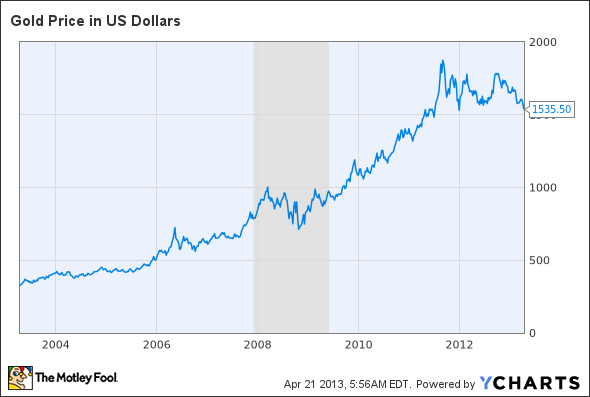
Gold Price in US Dollars Chart

Gold Price in US Dollars data by YCharts, Shaded area represents U.S. recession.

While I’m not sure I buy into conspiracy theories like that, I do know that if it’s true, then the Law of Unintended Consequences must surely be at play. There’s anecdotal evidence everywhere that despite the dumping of tons of paper gold assets on the market, demand for physical gold and silver has never been greater.

The new gold rush Bullion dealers are reporting they’re seeing individual purchases every bit as strong as occurred back in 2008. My bullion and coin dealer, JM Bullion, has upwards of a three-week delay in shipping American Silver Eagles, yet dealers everywhere are finding it increasingly difficult to get supply. Buyers from India to China are also racing to scoop up gold, with the China Gold Association reporting retail sales tripling in the country between April 15 and April 16, while Hong Kong and Macau have reported volume surges of as much as 150%.

Click below for the full article.

http://www.fool.com/investing/general/2013/04/21/gold-fell-to-1400-welcome-to-the-new-gold-rush.aspx
AP Poll: Trust in government, Obama approval slip

President Barack Obama’s re-election glow is gone. Congress’ reputation remains dismal. And only about one in five Americans say they trust the government to do what’s right most of the time, an Associated Press-GfK poll finds.

Most adults disapprove of Obama’s handling of the federal deficit, a festering national problem. But they also dislike key proposals to reduce deficit spending, including a slower growth in Social Security benefits and changes to Medicare.

Rounding out the portrait of a nation in a funk, the share of people saying the United States is heading in the wrong direction is at its highest since last August: 56 percent.

The government in Washington is “dealing with a lot of stuff that are non-issues,” said Jeremy Hammond, 33, of Queensbury, N.Y.

Hammond, a Web programmer and political independent, said Congress should focus on “the incredible debt and lack of spending control.” He said it’s absurd for Congress to force the Postal Service to continue Saturday mail delivery when the agency says “we can’t afford it.”

Hammond reflects the lukewarm feelings toward Obama found in the poll. Asked his opinion of the president, Hammond paused and said: “I don’t know. I voted for him in 2008, not in 2012.” When it comes to presidents, he said, “it’s one set of lawyers or the other.”

Click below for the full article.

http://news.yahoo.com/poll-trust-government-obama-approval-slip-164950163–politics.html

Associated Press: UnitedHealth warns of Medicare profit squeeze

UnitedHealth Group, the largest provider of Medicare Advantage plans, warned Thursday that funding cuts for the privately-run versions of the federal Medicare program will force it to reconsider its expectations for earnings growth next year.

CEO Stephen Hemsley told analysts that the government-subsidized coverage for elderly and disabled people faces a reimbursement cut of about 4 percent next year. That’s on top of other possible federal funding reductions and an expected 3 percent rise in medical costs.

“We did not expect the fastest-growing, most popular and most effective of the Medicare benefit options serving America’s seniors would be underfunded to this extent in 2014,” Hemsley said.

More than 13 million people were enrolled in Medicare Advantage plans last year, or about 27 percent of the Medicare population, according to the nonprofit Kaiser Family Foundation.

Insurers offer hundreds of different Medicare Advantage plans around the country. The coverage typically provides extras such as dental and vision care, or rates that are lower than standard Medicare.

UnitedHealth, which is the nation’s largest health insurer, has nearly 2.9 million people enrolled, and the plans brought in about 20 percent of the insurer’s revenue last year.

Shares of UnitedHealth and other insurers that provide Medicare Advantage coverage slid in February after the Centers for Medicare and Medicaid Services released data that pointed to payment cuts as steep as 8 percent next year. The government then softened the blow to a reduction of about 4 percent.

But UnitedHealth said that cut, combined with the other reductions, will be tough to stomach. UnitedHealth said it may have to trim benefits, change provider networks or leave some markets to preserve Medicare Advantage profitability.

Hemsley, UnitedHealth’s CEO, called the reimbursement cut “a significantly greater rate setback than anyone could have expected.”

The company also said widespread government spending cuts that started earlier this year and hit Medicare will make it hard for the insurer to reach the top end of its forecast for 2013 earnings of $5.25 to $5.50 per share. Analysts expect earnings of $5.51 per share, according to FactSet, a research firm.

Analysts had labeled UnitedHealth’s 2013 earnings forecast conservative after it came out last fall, and the insurer normally raises it several times through the year. But so far, the company has just backed the initial projection.

Thursday’s outlook warning came as UnitedHealth reported that its first-quarter earnings sank 14 percent, largely due to a lower gain the company recorded due to leftover insurance claims.

—

Click below for the full article.

http://finance.yahoo.com/news/unitedhealth-warns-medicare-profit-squeeze-175814694–finance.html


Motoramic: Why does the world’s largest automaker need $146.5 million from Kentucky?

On Friday, Toyota Chief Executive Akio Toyoda and Kentucky officials are expected to announce a $530 million expansion of Toyota’s sprawling Georgetown factory in the Bluegrass State so that it can build 50,000 Lexus ES sedans a year. In return for adding 570 permanent jobs, Kentucky will give Toyota a package of tax breaks and other incentives worth $146.5 million. Such deals are so common they rarely draw comment, but it’s worth asking: Why does the world’s largest automaker need a handout?

To get the incentives, Toyota promised to hire up to 570 new full-time workers at the Georgetown plant, along with 180 temporary workers. As the Louisville Courier-Journal reports, those permanent employees will be paid an average of $26 an hour in wages and benefits, a bit more than half of what long-time employees in Georgetown make.

It would be unfair to Toyota to single it out for taking a path trod so often by other automakers and corporations; in fact, it’s unheard of for an automaker from General Motors to Mitsubishi to expand a plant without some kind of government gift. Last December, The New York Times counted up 35 different grants to Ford from Kentucky alone between 2007 and 2010, totaling $307 million — which came even as the company cut jobs.

And those breaks pale to the deals automakers bargain for when they open new plants, with the current record held by Volkswagen, whose Tennessee factory came with incentives that total $577 million over several years. In return for those incentives, VW vowed to hire 2,000 full-time workers, for a cost of about $288,500 per job, a ratio that was the highest ever for a new auto assembly plant in the United States. When Kia opened its plant in Georgia in 2009, it did so only after driving a hard bargain for a $400 million incentive package, including everything from school property tax breaks to a free rail spur to ship cars from the factory.

State and local governments give automakers endless breaks for several reasons. A new auto plant often means additional jobs from parts suppliers on top of the add-on boost to the local economy. In tough times for American workers, automotive manufacturing jobs ofter stability and wages well above what’s available in most service industry careers. And many state officials fear being held to answer why a project was lost if the pot wasn’t sweet enough.

—

How do you feel about this government intervention?  Click below for the full article.

http://autos.yahoo.com/blogs/motoramic/why-does-world-largest-automaker-146-million-kentucky-164424807.html

Yahoo News: For Obama, stinging gun bill defeat is personal and political

What happens to a president who romps to reelection, channels a national tragedy that sparked coast-to-coast outrage into a deeply personal crusade, then fails to get a measure backed by nine out of ten Americans through the Senate, where his party holds a majority? Thanks to the NRA-fueled defeat of a bill that might have mildly tightened limits on gun sales, President Barack Obama is learning the hard way.

For the families of those killed or wounded by gun violence and who watched with judging eyes as the Senate killed the measure by a vote of 54-46 (it needed a supermajority of 60 votes to pass) what to make of the vote was an easy call.

“Shame on you!” Patricia Maisch shouted from the visitors gallery above the Senate floor.

Maisch, a grandmotherly figure who disarmed the shooter in the Tucson carnage that nearly claimed the life of former congresswoman Gabby Giffords, was happy to elaborate as reporters swarmed her after the vote. “I decided I could not sit still,” she said. “They have no souls, they have no compassion.”

But on Wednesday, they had the votes.

That’s Message One for Obama from this stinging legislative defeat: Having emotion and the majority on your side isn’t enough. NRA leader Wayne LaPierre, after all, didn’t even need to show up.

The knock on Obama has often been that he’s Mr. Spock, viewing his approach as the most logical and assuming that logic will trump the other’s side’s arguments and emotions. But only the most cynical observers will argue that the president didn’t take this fight personally – with frequent flashes of very public anger and anguish ever since the slaughter of 20 schoolchildren at Sandy Hook Elementary. And supporters of the legislation deployed the families of the slain as lobbyists in the weeks leading up to the vote.

Moreover, as the White House never tired of pointing out, polls show roughly 90 percent of Americans support expanded background checks.

“I will put everything I’ve got into this, and so will Joe,” Obama promised in January, with Vice President Biden at his side. “But I tell you, the only way we can change is if the American people demand it.”

In the end, though, four red-state Democrats joined 41 of the Senate’s 45 Republicans to defeat the bill. Why stick their necks out for legislation whose death in the Republican-led House of Representatives was essentially foreordained?

Click below for the full article.

http://news.yahoo.com/blogs/ticket/obama-stinging-gun-bill-defeat-personal-political-234849868–politics.html;_ylt=AhMEeTY6VfIiF8QAHtN7SpvyWed_;_ylu=X3oDMTQzNzlxa2ZiBG1pdANBcnRpY2xlIFRvcFN0b3JpZXMEcGtnA2QzMGIyZjAzLTk5OTEtMzY3My1hOWJiLTUwMTBjNjhkNmE5MgRwb3MDMgRzZWMDTWVkaWFTZWN0aW9uTGlzdAR2ZXIDYjBlMGU5NDMtYTdjMi0xMWUyLWFmZmUtNzM5MDdkZGMxMTA0;_ylg=X3oDMTNqcDRvMzU3BGludGwDdXMEbGFuZwNlbi11cwRwc3RhaWQDMjEwZTBhNzAtMzljNC0zNDg0LTg4MmUtZDAzYWU0ZTg3YjgxBHBzdGNhdAN1LXN8Y3JpbWVzYW5kdHJpYWxzBHB0A3N0b3J5cGFnZQR0ZXN0A1FFX1Rlc3Q-;_ylv=3

CNN: Senate rejects expanded gun background checks

In a major defeat for supporters of tougher gun laws, the U.S. Senate on Wednesday defeated a compromise plan to expand background checks on firearms sales as well as a proposal to ban some semi-automatic weapons modeled after military assault weapons.

The votes were on a series of amendments to a broad package of gun laws pushed by President Barack Obama and Democratic leaders in the aftermath of the Newtown school massacre in December.

However, fierce opposition by the powerful National Rifle Association led a backlash by conservative Republicans and a few Democrats from pro-gun states that doomed key proposals in the gun package, even after they had been watered down to try to satisfy opponents.

After the votes, Obama angrily criticized the NRA and senators who voted against the expanded background checks for rejecting a compromise he said was supported by a strong majority of Americans.

Click below for the full article.

http://www.cnn.com/2013/04/17/politics/senate-guns-vote/index.html

Wall St. Cheat Sheet: Are Your Income Taxes Fair?

With the official tax deadline in the rear view mirror, many Americans can now reflect on how much they paid Uncle Sam. If you feel like you are paying more than your “fair share,” you are not alone.

Unsurprisingly, Americans are losing faith in the fairness of income taxes. According to the latest Gallup survey, only 55 percent of Americans regard the income tax they pay as fair, the lowest reading since 2001. The results are based on Gallup’s Economy and Personal Finance poll and includes adults from all 50 states. It was conducted in the early part of April.

Click below for the full article.

http://wallstcheatsheet.com/stocks/are-your-income-taxes-fair.html/?ref=YF

CNBC Guide to Obamacare for Small Businesses

Even as you finish with this year’s taxes, if you’re a small-business owner experts say it’s time to look ahead to 2014, when the tax implications of the Affordable Care Act (ACA) begin to kick in.

“Just now, things are really sinking in that there is this employer responsibility,” said Amanda Austin, of the National Federation of Independent Business.

Under ACA, often called Obamacare, employers with 50 or more full-time workers face a mandate to provide insurance. It’s known formally as shared responsibility.

“You’re going to need somebody to do a thorough review of the impact on your business,” Austin said, because the new rules are complex.

For the complete article including more on the 50/30 rule, click the link below.

http://www.cnbc.com/id/100641995


Peter Schiff on CNBC About Gold Drop: We’re Headed To A Currency Crisis One Way Or Another

Video of Peter Schiff talking about potential currency crisis and his belief in Gold. Also below that is an older video of Peter Schiff on MSNBC debating policies of the FED as part of a panel. One thing to think about is the role of the Federal Reserve and whether it is good policy to inflate currency and print money out of thin air?